
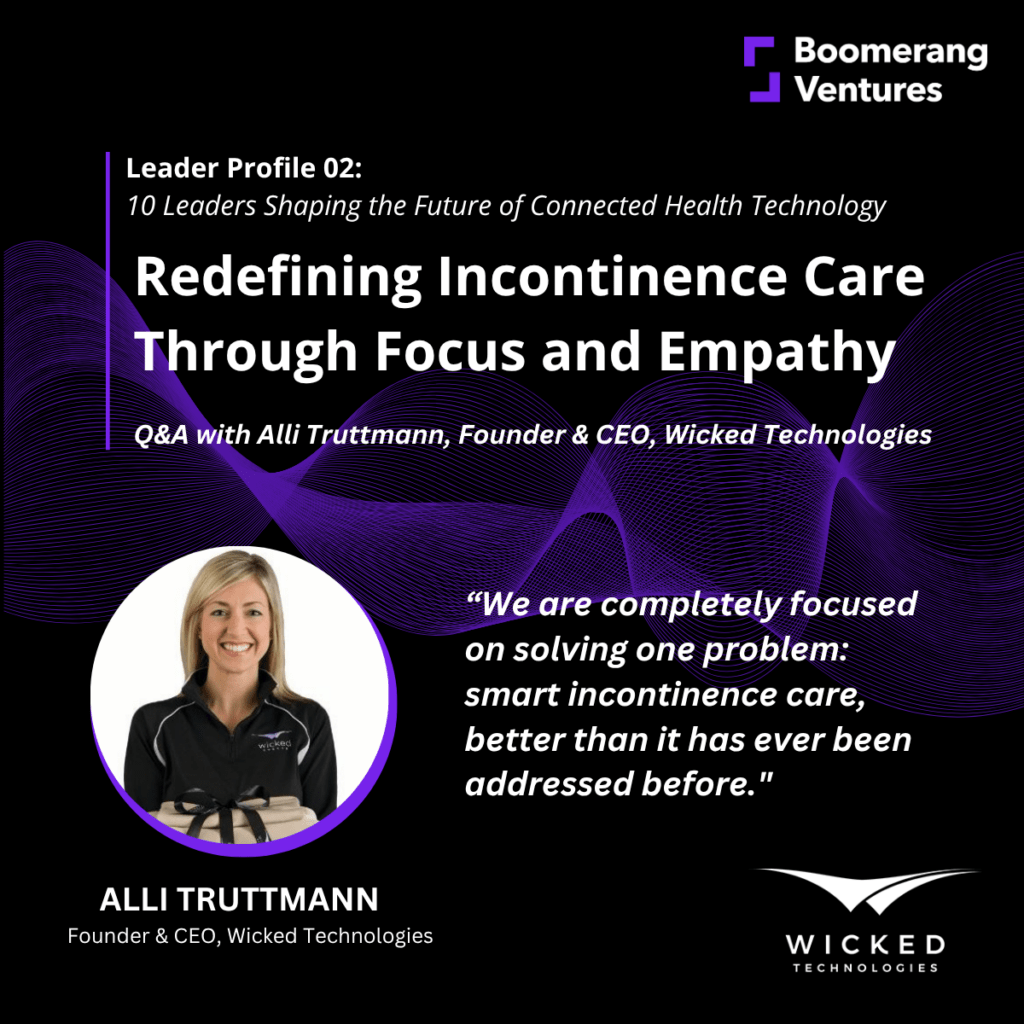
As part of Boomerang Ventures’ series highlighting leaders in its portfolio—introduced in “10 Leaders Shaping the Future of Connected Health Technology”—we feature executives driving innovation in connected health. These leaders advance solutions in some of healthcare’s most complex, underserved areas, from digital therapeutics to AI-enabled care delivery.
In this Q&A, Alli Truttmann, Founder & CEO of Wicked Technologies, shares how a personal experience inspired her to reimagine incontinence care, and how focusing on solving one problem drives change in senior care. With experience scaling consumer and healthcare products, Alli brings a disciplined, empathetic approach to innovation, grounded in clinical outcomes and real-world impact.
Origin & Strategic Insight
What inspired the creation of your company, and what unmet need did you initially see in the market?
The Wicked Smart Pad was inspired by my own grandmother’s end-of-life experience. I knew there had to be a better way to provide smarter, more dignified incontinence care. At the same time, it was clear that the senior living market was ready for innovation and that this was a problem worth solving at a much higher standard.
When did you realize this problem required a fundamentally different solution rather than incremental improvement?
It became clear during the research process. As I dug into the literature for our NIH grant application, I kept uncovering deeper issues, such as liability claims related to skin moisture, the high cost of treating pressure injuries, and the concept of “never events” in insurance. These are complications so preventable that they should never occur. That was the moment it clicked. This was not a problem that could be solved incrementally. It required a fundamentally different approach.
What makes your approach differentiated in today’s connected health landscape?
What sets us apart is radical focus. In healthcare, distractions abound—emerging modalities, adjacent markets, and new platforms. We ignore those. Our attention is fixed solely on solving one problem: smart incontinence care, better than it has ever been addressed before.
Every design decision, every clinical study, and every partnership runs through that single lens. When you stay focused on the customer and the outcome, the product improves faster, trust builds deeper, and the noise disappears. We are not trying to be everything to everyone. We are building the best smart incontinence care solution medtech has seen, and that clarity is a competitive advantage.
The Problem & Its Broader Impact
What is fundamentally broken in your segment of healthcare today?
Outdated care models that do not incorporate the use of technology.
Why has this issue persisted for so long without effective resolution?
The solution simply did not exist. And in cases where others attempted to address the problem, they did not fully understand the end user or the payor model. Without that alignment, solutions fail to gain traction.
If your solution scales as envisioned, how does it change outcomes for patients, providers, or payors?
Using the Wicked Smart Pad leads to better clinical outcomes. Patients experience fewer sleep interruptions, improved skin health due to faster response times, and fewer full bed changes.
For providers, this reduces physical strain and frees up time for more meaningful care. For payors, it reduces complications, hospitalizations, and overall costs. A better patient experience is not just the right thing to do. It is also the most efficient way to deliver care.
Building in Connected Health
What has been the most challenging aspect of building and scaling in this environment?
The biggest challenge has been balancing two opposing cultures. Startups are built to move fast and figure things out as they go. Regulated environments require documentation, structure, and precision. Both are necessary.
The challenge is teaching a fast-moving team to think in terms of systems and controls while ensuring compliance does not become an excuse to slow innovation. It is a constant balancing act, and one I am still learning to navigate intentionally.
What milestones validated that your company was ready for growth or broader adoption?
Receiving the NIH grant was a major validation. It signaled confidence for our investors and me, especially as we pivoted from a direct-to-consumer model into a regulated healthcare environment.
That funding allowed us to work closely with pilot partners and gather meaningful feedback. We have taken that data and are incorporating it into the next generation of our product and our broader business strategy.
How has working with Boomerang Ventures influenced your company’s trajectory?
Boomerang has been a rare find in venture capital, and I am incredibly grateful for the partnership. We are fortunate to be surrounded by life sciences companies in the Midwest, particularly in Indiana, but what makes Boomerang unique is that its founder stayed in the ecosystem and continues to invest in other companies.
Boomerang’s perspective is highly valued in our board discussions and in the decisions we make every day. We are fortunate to have both Boomerang’s support and its broader community of founders.
Leadership & Perspective
How do you view your role in shaping the future of healthcare innovation?
I believe women bring something to healthcare innovation that is often undervalued: empathy at the design level. It is not just about solving a clinical problem. It is about how the solution feels, looks, and integrates into someone’s most vulnerable moments.
Our product has to perform clinically, but it also has to feel right against someone’s skin, fit naturally into a care environment, and be something a caregiver accepts instinctively. That is not just engineering. It is intuition informed by empathy.
Have you encountered unique challenges as a female leader in venture-backed healthcare?
My biggest challenge has not been being a female founder. It has been building a physical product. Most venture capital firms are focused on SaaS models and software margins. Even though we have strong recurring revenue through a Hardware-as-a-Service model, we do not fit the typical mold.
That bias toward software has created real barriers.
What leadership principle guides your decision-making?
Ask the right few questions to make more decisions faster, even with limited information.
The Future of Connected Health Technology
Where do you see the biggest opportunity for transformation in healthcare?
Chronic care management and rural health applications represent some of the biggest opportunities for transformation over the next five years.
How will connected health technology redefine patient experience and access to care?
Connected health technology has the potential to shift care from a reactive model to a proactive one, especially for those who face the greatest barriers to access.
For patients in rural communities, individuals with mobility challenges, and those managing chronic conditions, remote monitoring, wearables, and telehealth platforms provide a continuous connection between patients and providers. Instead of waiting for conditions to escalate, clinicians can track data in real time, intervene earlier, and personalize care in ways previously not possible.
What does long-term success look like for your company?
Long-term success means creating a world where a person’s care setting no longer determines their access to the best tools for managing their health.
Today, we are proving our impact in private-pay assisted living and memory care environments. The clinical validation we are building is the foundation. Reimbursement will be the unlock. Financial performance is simply the evidence that the mission is working.
Quick Takes
One word that defines your company today:
Leverage
A book or experience that has shaped your leadership philosophy:
The Road Less Stupid by Keith Cunningham
Advice to the next generation of women in health tech:
Have a direct relationship with someone in regulatory who is not being paid to advise you.
Looking Ahead
Wicked Technologies is advancing a new standard for incontinence care, one that combines clinical performance with dignity, efficiency, and real-world usability. As the company continues to scale, it is positioned to redefine how care is delivered across senior living, chronic care, and beyond.
Wicked Technologies is currently raising capital to support its next phase of growth. To learn more, visit wickedsmartpad.com or connect directly with Alli Truttmann on LinkedIn.
Next month, we’ll continue the series with another leader driving meaningful progress across the connected health landscape.