As part of Boomerang Ventures’ ongoing series highlighting leaders across its portfolio—introduced in “10 Leaders Shaping the Future of Connected Health Technology”—we are featuring the executives driving innovation across the connected health landscape. These leaders are advancing solutions in some of healthcare’s most complex and underserved areas, from digital therapeutics to AI-enabled care delivery.
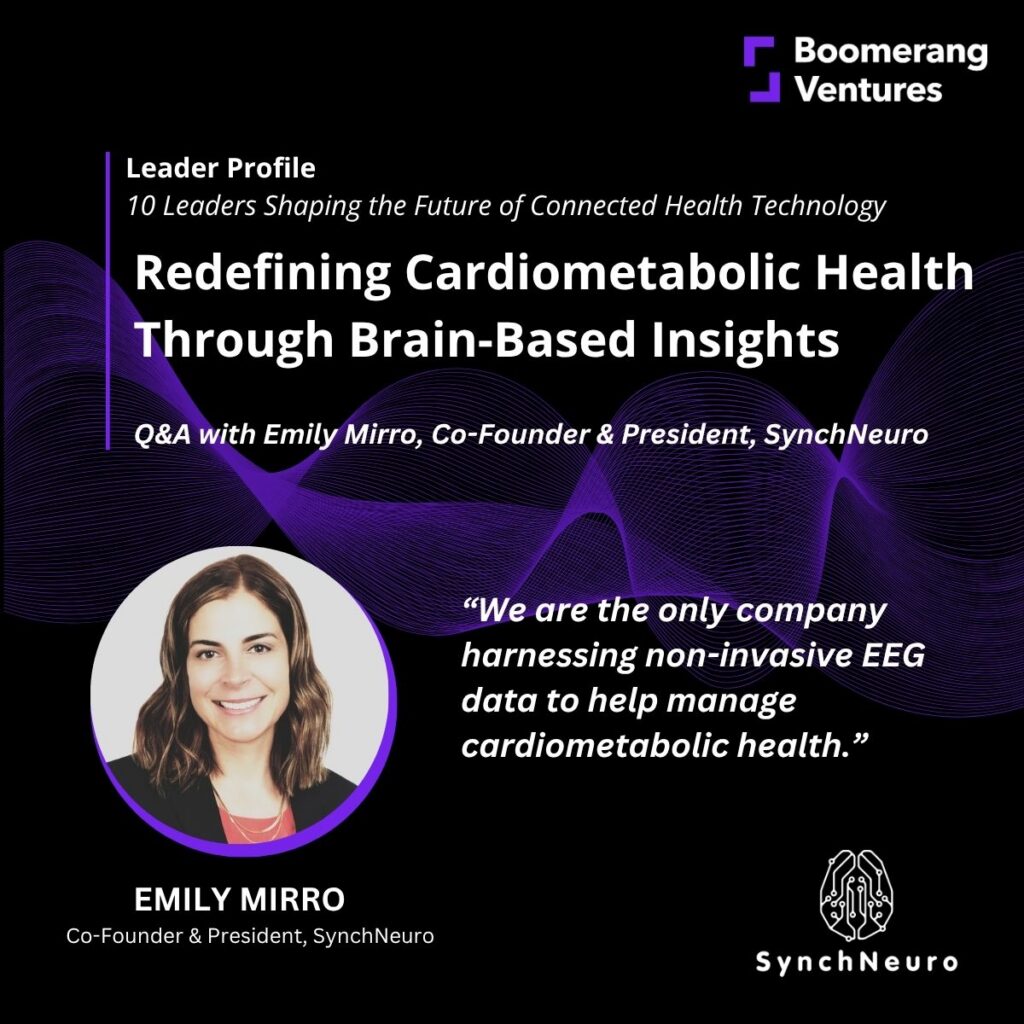
In this Q&A, Emily Mirro, Co-Founder & President of SynchNeuro, explains how her team pioneers a brain-signal-driven approach to cardiometabolic health. With more than 25 years in neurotechnology, Emily combines science, innovation, and practical application to address one of healthcare’s fastest-growing challenges.
Origin & Strategic Insight
What inspired the creation of your company, and what unmet need did you initially see in the market?
Our company was inspired by a discovery made by our founder, Dr. Casey Halpern, and his lab at Stanford—that brain signals can be decoded into glucose levels. I’ve spent more than 25 years working in neurotechnology, and over that time, I’ve become deeply interested in what continuous brain signal data can reveal about both the brain and the body. When I first saw the EEG-decoded glucose data from Casey’s lab, I knew I wanted to join him to build a company around it.
Because our backgrounds are in neuroscience, we had a lot to learn about diabetes. We spent a tremendous amount of time studying the landscape and speaking directly with patients to understand their experiences and biggest needs. Initially, we assumed we would focus on Type 1 diabetes, given the significant medical need. But what we discovered was that this population is already relatively well-served by existing tools.
We saw a real gap in people living with early-stage Type 2 diabetes and prediabetes. Many of these individuals don’t have access to specialists or insurance coverage for continuous glucose monitoring. They are often left without meaningful tools to manage their condition. It became clear this large, underserved population needed better insights and more accessible solutions. That’s the opportunity we chose to pursue.
When did you realize this problem required a fundamentally different solution rather than incremental improvement?
That realization came directly from our patient discovery work. We interviewed and surveyed thousands of individuals in our target market, and a consistent theme emerged: people want tools to monitor their cardiometabolic health, but the existing solutions aren’t designed for them.
People need something easy to understand that provides proactive and personalized guidance. They want motivation to make sustainable lifestyle changes. Just as importantly, it has to be affordable. Most early-stage patients don’t have insurance coverage for current solutions.
Those insights made it clear that incremental improvements wouldn’t be enough. The real opportunity was to rethink the entire approach—creating something more accessible, actionable, and aligned with everyday needs.
What makes your approach differentiated in today’s connected health landscape?
We are the only company harnessing non-invasive EEG data to help manage cardiometabolic health. Today’s connected health ecosystem is filled with devices that each measure a single aspect of health—whether it’s sleep, glucose, or general wellness.
What we’re doing differently is bringing those insights together in a single, discreet wearable that sits behind the ear. By combining continuous brain signal data with other physiological signals, we provide a more holistic picture of cardiometabolic health. Our goal is to move beyond isolated measurements and deliver meaningful, actionable insights. This helps people understand how their lifestyle choices affect their metabolism in real time.
The Problem & Its Broader Impact
What is fundamentally broken in your segment of healthcare today?
Diabetes is one of the most common and fastest-growing chronic diseases worldwide. In prediabetes and early-stage Type 2 diabetes, it’s often possible to prevent or reverse the condition through lifestyle changes. However, our healthcare system isn’t designed to intervene at that stage.
In many cases, patients don’t receive meaningful education or tools until their condition has progressed significantly. At that point, the focus shifts to managing complications rather than altering the disease’s trajectory. We believe there is a better approach—one that empowers people earlier, when lifestyle changes can have the greatest impact.
Why has this issue persisted for so long without effective resolution?
For a long time, the healthcare system lacked the tools to monitor metabolic health in a preventive, scalable way. Most technologies were designed for patients already managing advanced diabetes, not for the much larger population at risk.
As a result, clinicians have relied on occasional lab tests and annual visits, which don’t provide the continuous insight needed to understand how daily behaviors impact metabolic health.
What’s changing now is the emergence of non-invasive sensing technologies and connected health platforms. These innovations finally give us the ability to shift from a reactive to a proactive, preventive model.
If your solution scales as envisioned, how does it change outcomes for patients, providers, or payors?
If our solution scales as envisioned, it fundamentally shifts diabetes care toward prevention and empowerment.
For patients, it means gaining real-time insights that help them stop or even reverse disease progression. Instead of feeling powerless, they can see how daily behaviors affect their health and make meaningful changes. Our platform also fosters a sense of community to help sustain those behaviors over time.
For providers, it offers a practical way to extend care beyond the clinic without adding a significant burden. And for payors and healthcare systems, it reduces long-term costs by preventing complications and lowering reliance on medications and interventions.
Building in Connected Health
What has been the most challenging aspect of building and scaling in this environment?
One of the biggest challenges is balancing the urgency of innovation with the responsibility of building health-impacting technologies. In healthcare, you’re not just developing a product. You’re building clinical evidence, navigating regulatory pathways, earning provider trust, and planning for scalability. All this happens at once.
For a startup, that means constantly aligning science, technology, and the realities of the healthcare system. A big part of my role has been building a team that understands both the innovation side and the healthcare ecosystem so we can move forward thoughtfully while maintaining momentum.
What milestones validated that your company was ready for growth or broader adoption?
One key milestone was validating that patients truly want and value our solution. In an independent market research study with hundreds of individuals living with non-insulin-treated diabetes, 88% said they would feel more in control of their health with our system, and 68% indicated they would be ready to purchase it if it were available.
That level of engagement gave us strong confidence that we are addressing a real need and that the market is ready for a new approach.
How has working with Boomerang Ventures influenced your company’s trajectory?
Although we are a relatively new addition to the Boomerang portfolio, their impact has already been meaningful. They’ve helped us think through both our near- and long-term financing strategies, which are critical for scaling responsibly.
What stands out most is their level of engagement. They bring not only capital, but also thoughtful strategic guidance and a genuine willingness to roll up their sleeves and help us navigate key decisions.
Leadership & Perspective
How do you view your role in shaping the future of healthcare innovation?
I hope that by leading a health tech company, I can inspire more women to pursue leadership roles in this space. Diverse leadership brings different perspectives, ultimately leading to better solutions for patients.
I also believe in actively supporting other women—through mentorship, introductions, and advocacy. Progress doesn’t happen automatically, and supporting one another is essential to driving meaningful change.
Have you encountered unique challenges as a female leader in venture-backed healthcare?
Like many women in venture-backed startups, I’ve experienced gender bias, particularly during fundraising. It’s often subtle, but it’s there.
Those experiences have strengthened my resilience and reinforced the importance of being confident in our vision, prepared with data, and persistent in finding the right partners.
I’ve also been fortunate to have a highly supportive cofounder. Casey consistently highlights my contributions and ensures our leadership feels truly collaborative, which has been instrumental in building the company.
What leadership principle guides your decision-making?
The principle that guides me most is staying deeply connected to our customers. In times of uncertainty or growth, it’s easy to get distracted, but understanding our customers better than anyone else keeps us focused.
If we remain committed to solving real problems for patients, it becomes much easier to prioritize the right opportunities and avoid the wrong ones.
The Future of Connected Health Technology
Where do you see the biggest opportunity for transformation in healthcare?
Today, about half of Americans wear some form of health wearable, and I expect that number to grow significantly in the next five years. That creates an incredible opportunity to rethink how people engage with their health.
The next step is making that data more personalized, actionable, and meaningful. When people can clearly see how their behaviors impact their health, they become more engaged and empowered to make better decisions.
This shift has the potential to prevent acute events and slow the progression of chronic diseases—marking a meaningful transition toward a more proactive model of care.
How will connected health technology redefine patient experience?
Connected health is shifting care from something people experience occasionally in a clinic to something they engage with every day. Instead of relying on a few data points, patients can now access continuous insights about their health.
That visibility is incredibly empowering. It allows people to act earlier and make more informed decisions. At the same time, it enables providers to extend care beyond the clinic and support more patients more effectively.
What does long-term success look like for your company?
Long-term success means making personalized cardiometabolic health monitoring accessible to millions of people who currently don’t have the tools to understand or manage their health.
If we succeed, people will have a simple, affordable way to see how their daily choices impact their health and take action before their condition progresses.
Quick Takes
One word that defines your company today:
Visionary
A leadership lesson that has shaped your philosophy:
A strong, positive company culture is one of the most important drivers of success. That culture starts with leadership. Leaders have to embody the company’s values, stay aligned on strategy, communicate transparently, welcome feedback, and support their teams. It’s harder than it sounds but when it’s done well it becomes incredibly powerful.
Advice to the next generation of women in health tech:
Step up to the plate every time you have the chance, especially when it’s hard. You may fail, but you will always learn, and you’ll never regret trying. Let meaningful actions define your career, it means more than what’s on your resume.
Looking Ahead
SynchNeuro is advancing a new approach to cardiometabolic health—one that prioritizes early insight, continuous monitoring, and patient empowerment. As the company continues to grow, it is positioned to help shift diabetes care from reactive management to proactive prevention.
SynchNeuro is currently raising capital to support its next phase of growth. To learn more, visit synchneuro.com or connect directly with Emily Mirro on LinkedIn.
The series continues next month with another leader shaping the future of connected health innovation.