As part of Boomerang Ventures’ ongoing series highlighting women leaders across its portfolio—introduced in “10 Leaders Shaping the Future of Connected Health Technology”—we are featuring the executives driving innovation across the connected health landscape. These leaders are advancing solutions in some of healthcare’s most complex and underserved areas, from digital therapeutics to AI-enabled care delivery. Against this backdrop, we turn our focus to musculoskeletal (MSK) care and the innovators leading change in this domain.
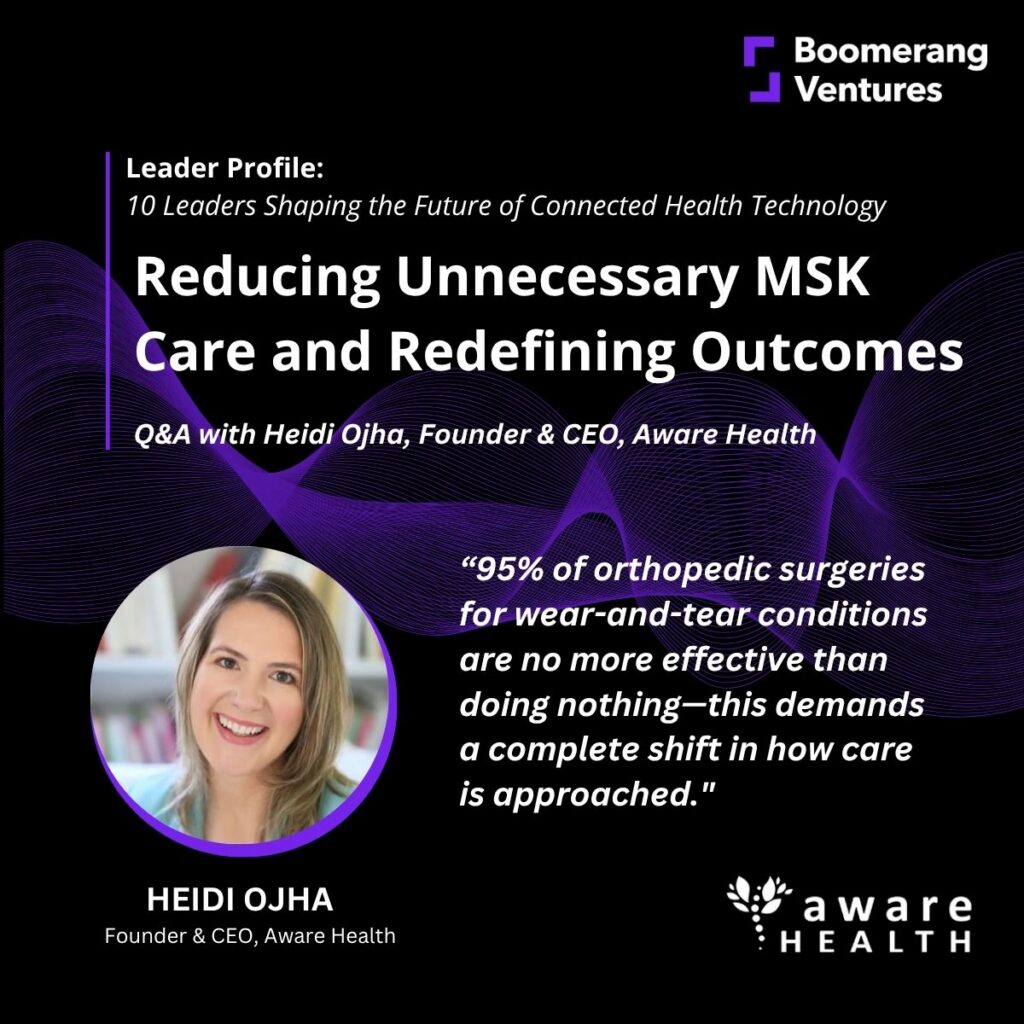
In this Q&A, Heidi Ojha, Founder & CEO of Aware Health, shares how she is reshaping MSK care through a model focused on reducing unnecessary surgeries and bending the cost curve. With more than 20 years of experience in orthopedic and MSK care, Heidi has built her career around improving outcomes while lowering costs, emerging as a leading voice in direct-to-employer healthcare and value-based care innovation. She now brings that expertise to scaling a model designed to deliver better care at a fraction of the cost.
Origin & Strategic Insight
What inspired the creation of your company, and what unmet need did you initially see in the market?
My 20-year journey in musculoskeletal care has been focused on delivering better care at lower cost by reducing unnecessary surgeries. I’ve been deeply involved in advancing direct-to-employer models where physical therapists lead triage and care. Through that work, it became clear that there was a major opportunity to rethink how MSK care is delivered, starting with more effective, evidence-based decision-making at the front end.
When did you realize this problem required a fundamentally different solution rather than incremental improvement?
The turning point was research showing that 95% of orthopedic surgeries for wear-and-tear conditions are no more effective than doing nothing. That level of inefficiency doesn’t call for incremental change, it requires a complete shift in how care is approached.
What makes your approach differentiated in today’s connected health landscape?
Our model is designed to bend the MSK cost curve, which typically rises steadily over time. No other MSK company has consistently demonstrated the ability to reverse that trend. We focus on delivering better outcomes and lowering costs, compounding impact over time.
The Problem & Its Broader Impact
What is fundamentally broken in your segment of healthcare today?
There’s a widespread belief that imaging is the best way to diagnose MSK conditions. While imaging is essential in many areas of medicine, in MSK it often leads to overdiagnosis and unnecessary surgeries that could be avoided.
Why has this issue persisted for so long without effective resolution?
There is a 10-year lag between what is published in research and implemented in clinics. We bring unique value by being the first true domain expert to target MSK overdiagnosis and unnecessary surgery directly, bringing research immediately to practice. Our real-time selling, learning, and iterating drive results few can match, allowing us to advance more quickly than legacy competitors.
If your solution scales as envisioned, how does it change outcomes for patients, providers, or payors?
It delivers better care while reducing the rising costs that is, quite honestly, starting to put companies out of business. Aware saves self-insured companies up to 10% of their overall healthcare costs—and that impact compounds over time. For patients, it means a better quality of life. Grandparents can stay active with their grandchildren. People maintain mobility longer. In many ways, we’re helping people function as they did when they were younger.
Building in Connected Health
Healthcare is complex and highly regulated. What has been the most challenging aspect of building and scaling in this environment?
While we are getting strong engagement currently for large customers, we are always trying to maintain quality of care and high engagement as we move upmarket. Four times the engagement compared with competitors’ engagement, means four times more surgeries avoided.
How has working with Boomerang Ventures influenced your company’s trajectory?
Boomerang Ventures introduced us to a payer request for proposals (RFP), which has led to direct conversations with a Chief Medical Officer. That level of access is incredibly valuable as we scale.
Leadership & Perspective
As a woman leading a health tech company, how do you view your role in shaping the future of healthcare innovation?
Women tend to take a highly relational approach, and that translates directly into patient-centered care. Women are also more likely to seek care, so having women design these solutions increases the likelihood that they will truly resonate and work.
Have you encountered unique challenges as a female leader in venture-backed healthcare? If so, how have they shaped your leadership approach?
I personally can’t rely on prior exits or reputation—I have to consistently prove that the model works through results. For us, that means demonstrating strong, sustained year-over-year revenue growth.
What leadership principle guides your decision-making during periods of uncertainty or growth?
Founders need to love learning. Especially for women balancing multiple responsibilities, if the work itself is rooted in learning, it never feels like a burden. That mindset carries you through the toughest moments—and there are many!
The Future of Connected Health Technology
Where do you see the biggest opportunity for transformation in healthcare over the next five years?
Shifting to a value-based care subscription model instead of traditional fee-for-service structures. That’s where real transformation will happen.
How do you believe connected health technology will redefine patient experience and access to care?
Patients want answers at their fingertips. AI will play a major role in shaping the future of how care is delivered and accessed.
What does long-term success look like for your company beyond financial performance?
Setting the industry standard for simple, efficient MSK care and reaching 10 million people with a better way to manage their health, helping them avoid going under the knife and thrive in life!
Quick Takes
One word that defines your company today:
Hive-Passion
A book, lesson, or experience that has shaped your leadership philosophy:
You Are a Badass®: How to Stop Doubting Your Greatness and Start Living an Awesome Life
A piece of advice you would give to the next generation of women entering health tech:
Believe—and it will happen.
Looking Ahead
Aware Health is advancing a new model for musculoskeletal care—one that prioritizes outcomes, reduces unnecessary interventions, and lowers costs at scale. As the company continues to grow, it is positioned to redefine how MSK care is delivered across employer and payer ecosystems.
Aware Health is currently raising capital to support its next phase of growth. To learn more, visit awarehealth.io and connect directly with Heidi Ojha on LinkedIn.
Next month, we’ll continue this series, spotlighting another leader driving meaningful change across the connected health landscape.