
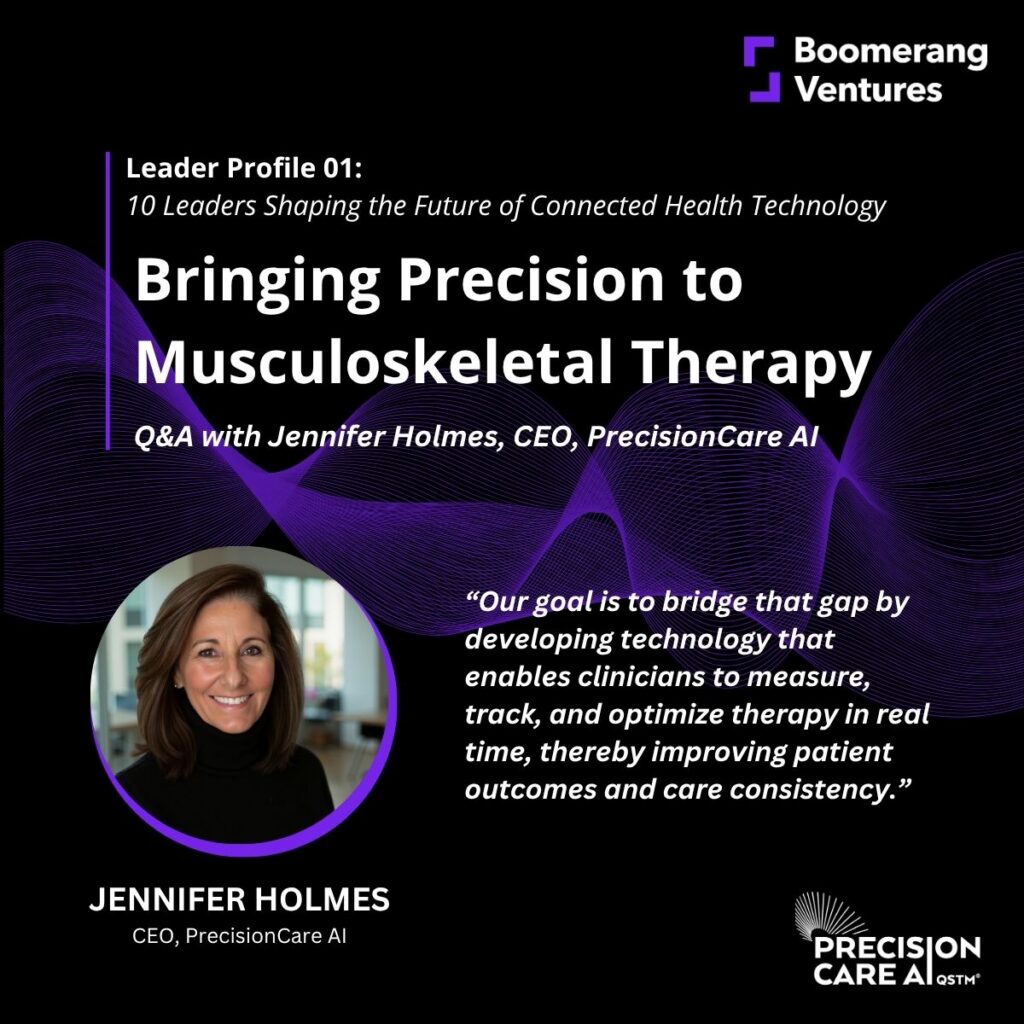
As part of Boomerang Ventures’ ongoing series highlighting leaders across its portfolio—introduced in “10 Leaders Shaping the Future of Connected Health Technology”—we are featuring the founders and CEOs driving innovation across the connected health landscape. These leaders are advancing solutions in some of healthcare’s most complex and underserved areas, from digital therapeutics to AI-enabled care delivery.
In this Q&A, Jennifer Holmes, CEO of PrecisionCare AI, shares how she is transforming musculoskeletal care through data-driven therapy, the challenges of scaling within healthcare, and what it takes to bring greater precision to physical rehabilitation. With more than 30 years of experience across medical device and health technology companies, Jennifer has led commercial growth, operational turnarounds, and successful exit strategies, including guiding a company through acquisition by a major private equity firm. Her leadership spans some of the industry’s most recognized organizations, where she has consistently driven revenue growth, launched innovative solutions, and built high-performing teams—experience she now brings to advancing precision in musculoskeletal (MSK) rehabilitation.
Origin & Strategic Perspective
What inspired the creation of PrecisionCare AI, and what unmet need did you initially see in the market?
PrecisionCare AI was created to bring objective measurement and precision to musculoskeletal therapy—an area of healthcare that has traditionally relied heavily on subjective assessment. There has long been a gap between the sophistication of diagnostic tools and the lack of quantifiable data guiding soft tissue treatment and rehabilitation. Our goal is to bridge that gap by developing technology that enables clinicians to measure, track, and optimize therapy in real time, thereby improving patient outcomes and care consistency.
What drew you to lead this company, and what opportunity did you recognize in its mission and technology?
I was drawn to PrecisionCare AI because it addresses one of the most persistent gaps in rehabilitation medicine—particularly within manual therapy—the absence of objective, quantifiable data to guide treatment. Despite being a cornerstone of musculoskeletal care, soft tissue therapy has historically relied on clinician experience and subjective assessment rather than measurable metrics. PrecisionCare AI’s Quantifiable Soft Tissue Manipulation (QSTM®) technology introduces a new paradigm by bringing data, measurement, and repeatability to an area of care that has long lacked standardized feedback.
What excited me most was the opportunity to apply precision medicine principlesto physical rehabilitation. By providing clinicians with real-time metrics that quantify tissue response and treatment delivery, QSTM has the potential to transform manual therapy from an experience-driven practice into a data-informed, outcomes-driven discipline. I saw an opportunity to help scale a platform that not only enhances clinical decision-making but also establishes measurable standards in musculoskeletal care, ultimately improving rehabilitation outcomes for millions of patients.
When did you realize this problem required a fundamentally different solution rather than incremental improvement?
It became clear that incremental improvements to traditional therapy tools weren’t enough when we looked at how little objective data clinicians had during treatment. While diagnostics like imaging have advanced dramatically, the therapeutic process itself has remained largely unmeasured. That realization drove the need for a fundamentally different approach—one that integrates sensing, analytics, and real-time feedback directly into therapy so treatment can be quantified, personalized, and continuously optimized.
What makes your approach differentiated in today’s connected health landscape?
PrecisionCare AI differentiates itself by bringing real-time, quantifiable metrics directly into the therapy session. Our QSTM platform captures data on tissue response and treatment parameters, enabling clinicians to deliver more precise and repeatable care. By turning soft tissue therapy into measurable data, we create a new layer of insight that supports better clinical decisions, improved outcomes, and scalable rehabilitation across healthcare systems.
The Problem & Its Broader Impact
What is fundamentally broken in your segment of healthcare today?
Musculoskeletal care is one of the largest and most costly areas of healthcare, yet much soft-tissue therapy is still delivered without objective measurement. Clinicians often rely on experience and patient feedback rather than quantifiable data to guide treatment. This lack of real-time insight makes it difficult to standardize care, measure effectiveness, or optimize outcomes across providers and health systems.
Why has this issue persisted for so long without effective resolution?
Historically, soft tissue therapy has been difficult to measure because the tools and technology simply didn’t exist to capture meaningful data during treatment. While diagnostics like imaging have advanced significantly, the therapeutic process itself has remained largely analog. Without technology capable of measuring tissue response and treatment parameters in real time, progress relied on incremental improvements rather than a true shift toward data-driven therapy.
If your solution scales as envisioned, how does it change outcomes for patients, providers, or payors?
If PrecisionCare AI scales as envisioned, it brings measurable precision to musculoskeletal therapy.
- Patients benefit from more personalized treatment and faster recovery timelines.
- Providers gain objective data to guide clinical decisions and demonstrate effectiveness.
- Payors gain greater transparency into outcomes and the value of care.
Ultimately, it transforms rehabilitation from a largely subjective process into a measurable, data-driven model that improves both clinical and economic outcomes.
Building in Connected Health
Healthcare is complex and highly regulated. What has been the most challenging aspect of building and scaling in this environment?
The biggest challenge is navigating the intersection of innovation, clinical validation, and regulatory compliance. Healthcare technologies must not only demonstrate clear clinical value but also meet rigorous regulatory and data security standards. Balancing the speed of innovation with the discipline required for regulatory readiness and clinical credibility is essential—and it requires strong partnerships and careful execution.
What milestones validated that your company was ready for growth or broader adoption?
Key milestones included validating the clinical relevance of our technology with leading rehabilitation providers, establishing strategic partnerships with large physical therapy networks, and building a development framework aligned with regulatory pathways. These steps demonstrated that our platform could integrate into real-world clinical environments while delivering measurable value to both providers and patients.
How has working with Boomerang Ventures influenced your company’s trajectory?
Working with Boomerang Ventures has been instrumental in accelerating our progress. The firm’s venture studio model provides more than capital—it offers deep operational expertise across product development, regulatory strategy, and healthcare commercialization. That combination of strategic guidance and hands-on support has helped us move from concept to execution faster and with greater discipline.
Looking Ahead
PrecisionCare AI is advancing a new standard for musculoskeletal therapy—one grounded in data, precision, and measurable outcomes. As the company continues to scale its QSTM platform, it is positioned to play a key role in transforming rehabilitation into a more consistent, transparent, and outcomes-driven model of care.
PrecisionCare AI is currently raising capital to support its next phase of growth. To learn more, visit precisioncare-ai.com and connect directly with Jennifer Holmes on LinkedIn.
Stay tuned as we continue this series next month, featuring another leader at the forefront of innovation in connected health technology.