

Primary Record is a Portfolio Company of Boomerang Ventures
Source: Indianapolis Business Journal
When Fishers-based startup Primary Record first sought venture capital in 2023, the medical records company raised $1 million with relative ease.
Three years later, raising a fraction of that amount proved more difficult, company co-founder Jim McIntosh said.
Primary Record was originally designed to give patients and care coordinators easier access to medical records, but the market has grown more slowly than expected, McIntosh said.
The company found a new growth opportunity in mobile integrated health, an emerging approach in which health care providers deliver services in patients’ homes. The field has benefited from federal funding through the Rural Health Transformation Program.
But the shift required time and money.
“We were just looking for $50,000 and weren’t getting much response from our existing investors,” he said.
Primary Record ultimately secured $91,000, largely through an investment and corporate partnership with Crown Point-based HealthCall LLC, supplemented by funding from angel investors, McIntosh said.
Still, McIntosh said investors seemed more cautious than when the company first raised money.
“They’re wanting to look at proven revenue and more product-market fit before putting in money,” McIntosh said.
Startup founders and organizations across Indiana’s entrepreneurial ecosystem tell IBJ that investors have set a higher bar for funding this year, particularly for software companies.
“I’ve had a couple of companies that actually stopped their fundraising and decided to focus just on bootstrapping and getting more customers,” said Courtney Zaugg, co-founder of VentureVets, an accelerator for veteran-connected businesses.
Zaugg said she believes that’s likely a good decision given the reticence of investors. Still, she noted that many of those businesses will eventually need venture funding.
“In order for some folks to win, they have to grow really fast,” she said. “In order to grow really fast, you need time, [people] and money.”
The slowdown in venture investing in central Indiana follows a decade of rising activity.
From 2016 through 2024, venture capital investment in central Indiana companies averaged about $81 million per quarter. Over the past two years, that average has fallen to about $51 million.
In the third quarter of 2026, venture investment in central Indiana fell to a 10-year low, IBJ has reported. The region typically accounts for most of the state’s venture capital activity.
But the problem doesn’t appear to be a lack of money to be invested – there’s plenty of money nationally, experts tell IBJ. Instead, it’s where funders are putting the money, both in terms of geography and industry.
An increasing amount of investment nationally has concentrated into one particularly high-growth and disruptive industry — artificial intelligence. And it’s gone to a handful of locations along the East and West coasts.
Kristian Andersen, co-founder and partner at Indianapolis-based venture firm High Alpha, said AI has made it cheaper than ever to start a company, partly by reducing early staffing needs. In the past, lower startup costs and high growth potential might have been enough to attract investors.
But today, startups are being measured against the huge returns that AI companies are expected to generate — and most fledgling companies can’t measure up.
“What’s qualified as a good investment has changed dramatically over the last couple of years,” Andersen said.
Those national pressures have compounded a local challenge: Relatively few Indiana startups have gone public or been acquired at valuations large enough to generate substantial returns for investors and founders. Those exits can create wealth that is reinvested in the state’s next generation of startups.
For example, several of the partners who founded High Alpha had been executives at Indianapolis-based software company ExactTarget, which went public in 2012, raising $161.5 million in its initial stock offering. The company was acquired in 2013 by Salesforce for $2.5 billion.
The partners reinvested some of their ExactTarget earnings into High Alpha, which in turn invested in other startups.
Without those kinds of exits, “your capital is literally locked in your existing portfolio,” said Megan Glover, who chairs the Indiana Technology and Innovation Association’s Capital Committee.
Glover founded Zionsville-based 120Water, which has raised $57.6 million in multiple private funding rounds. She stepped down as CEO about a year ago and left the company in April. She is now chief digital officer at Usalco, a Baltimore-based water treatment chemical manufacturer, but remains based in Indiana.
Glover said investors whose capital is tied up in existing Midwest companies “may be missing out on incredible startups that want to be funded.”
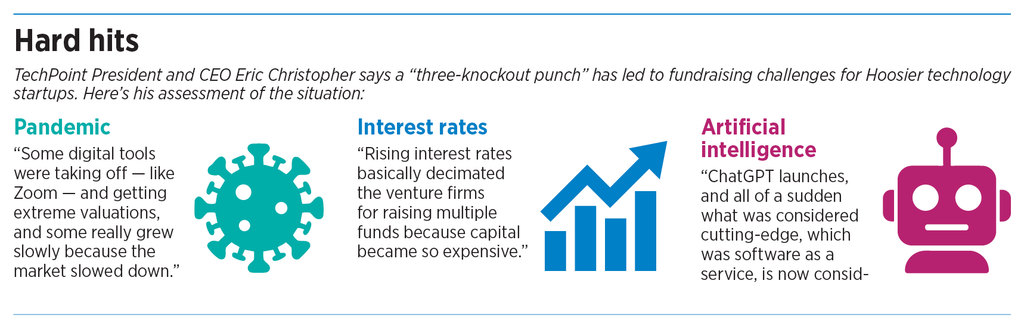
TechPoint CEO Eric Christopher described a “three-knockout punch” affecting startups and venture investors. The first blow, he said, was the pandemic, which accelerated growth for some startups while leaving others struggling.
The second was higher interest rates, which made safer investments more attractive to the investors who provide capital to venture firms, Christopher said. That made it more difficult for venture firms to raise money.
The third was the rise of AI.
“All of a sudden what was considered cutting edge, which was software as a service, is now considered legacy,” he said.
Indiana’s added challenges
Changes in state investment policy have added to the challenges facing Indiana startups, Glover said.
In 2025, shortly after taking office, Gov. Mike Braun launched an investigation that included Elevate Ventures, the nonprofit that had served as the state’s startup investment arm. For months, state funding to Elevate and the nonprofit’s investments were frozen or slowed, creating uncertainty for startups seeking capital and investors who relied on Elevate as a co-investor in early-stage companies.
In December 2025, the Braun administration paused venture investments from the state’s Next Level Fund and later ended them. The fund had been established with $250 million from the 2006 lease of the Indiana Toll Road to invest in Indiana startups.
State officials decided to redirect the money toward investments intended to generate returns more quickly, with proceeds available to the Indiana Department of Transportation for road projects.
Despite those moves, Glover said there are indications that the Braun administration and Indiana’s tech industry are aligning more on how the state can play a role in attracting outside capital.
“It’s a slightly different conversation that we’re having now compared to a couple of years ago, which is: ‘Small business can be both innovative businesses and brick and mortar,’” she said.
The end of the operational pause at Elevate has allowed it to resume raising money for what is expected to be a $150 million Growth Fund for more established companies seeking later rounds of funding. That fund is to include $25 million from the state’s returns on past investments plus private capital that Elevate raises.
Funding for expansion has long been a challenge for Indiana startups, even as investors have become increasingly interested in more established companies, said Elevate CEO Christopher “Toph” Day. He said the new Growth Fund could help close that gap.
High Alpha’s Andersen said he supports more capital being infused into central Indiana’s venture ecosystem, but he said that alone won’t be enough to move the needle. The company has to be strong.
“If you build a breakout company, the money will come,” he said.
Growth avenues
So which central Indiana companies are most likely to be successful at attracting more capital in this new environment?
To start: companies that can apply AI to a specific problem that might have been previously solved by software, said TechPoint’s Christopher.
Many software companies are integrating AI to remain competitive, Christopher said, but venture investors are showing greater interest in businesses built around AI from the outset, known as “AI-native” companies.
But even founders like Matthew Wallace, CEO of the AI-native company Onow Ascent Inc. noted there’s still a “higher bar” for investment. The Carmel-based company provides AI software that helps small wholesalers in Southeast Asia and sub-Saharan Africa track invoices and collect payments.
“You’re not raising on a pitch deck,” he said. “You’re raising on [that] you actually built something and now you’re demonstrating that for us. The next round for us is there is actually a buyer.”
However, Wallace said that not having such easy access to funds in the current environment isn’t the same setback it might have historically been.
With AI to help with company tasks, the money raised from Onow Ascent’s friends and family fundraising round went further than expected, he said.
“I expected I was raising for 7 months of runway, and it was actually 16 months of runway,” Wallace said.
Beyond AI, Indiana’s manufacturing base could likely allow it to thrive in venture capital’s growing investments into “hardtech,” such as robotics and advanced manufacturing, Day said. The interest has grown as software has become a less reliable investment and federal incentives for domestic manufacturing have continued to grow.
Day said more than half of Elevate’s Growth Fund could go to companies that “make something physical.”
“Historically we were 60% [software] and 40% [hard tech], I can see that flipping at minimum,” he said, adding that the share of hard-tech startups nabbing investments could grow even larger.
Source: Indianapolis Business Journal, October 30, 2026